Important: The information in this article is intended for general guidance for employers and hiring professionals. It is not legal advice, and organizations should consult their legal or compliance advisors when developing hiring or background screening policies. If you are an individual looking to obtain a background check on yourself or inquire about a background report, please contact the screening provider that performed the report or the employer who requested it. Justifacts provides screening services for employers and does not process personal background check requests through this website.
Someone on your leadership team says to run a background check on the finalist, and it sounds simple until you try to act on it. Do you search court records yourself? Buy a report off a site promising results in 30 seconds? For almost every employer the answer is a background check service, and knowing what that phrase covers is the difference between a hire you can defend and a report you can't use.
The confusion is fair. Screening sits between HR and legal, most hiring managers deal with it a few times a year, and the market is full of instant-search sites that look like the same product for a fraction of the price. This guide covers what a background check service is, what one includes, how the process runs, and the obligations that come with using one. It's written for HR and compliance teams at organizations of 5,000 employees or fewer.
Quick Answer
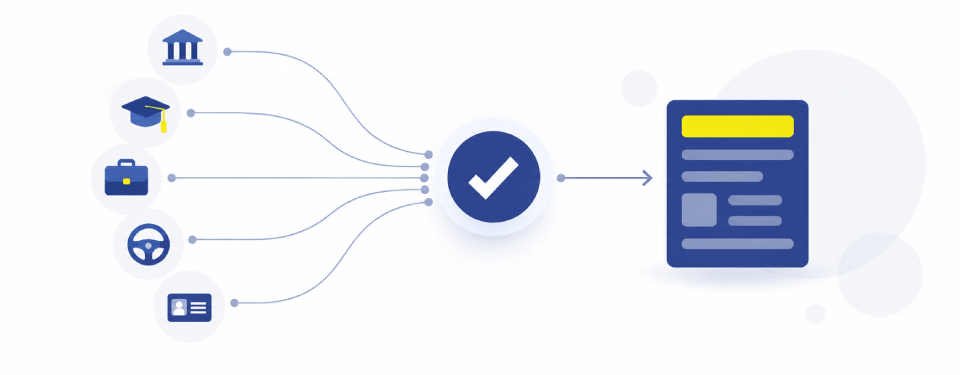
A background check service is a company that collects, verifies, and reports employment screening information to employers under the Fair Credit Reporting Act (FCRA). In legal terms it's a consumer reporting agency, or CRA, which means it's regulated and accountable for the accuracy of what it reports. A typical service covers criminal history, employment and education verification, and identity verification, with drug screening and driving records added by role. The service handles sourcing and verification. The employer handles consent, review, and the decision.
Table of Contents
- What Is a Background Check Service?
- What Do Background Check Services Include?
- How Does the Background Check Process Work for Employers?
- What to Look for in a Background Check Service Provider
- Employer Considerations
- Compliance Considerations
- Why Work with Justifacts?
What Is a Background Check Service?
A background check service is a consumer reporting agency: a company regulated under the FCRA that gathers, verifies, and reports employment screening information on an employer's behalf.
That label does real work. Once a third party supplies information about a candidate for a hiring decision, federal law treats it as a consumer report, and both sides pick up obligations: consent collected a specific way, a documented dispute route for the candidate, and reasonable procedures to get the record right. None of that applies when you search a name yourself.
Most of the effort goes into sourcing and verification rather than searching. The provider first confirms you're a real employer with a permissible purpose, usually through credentialing and a site inspection. Each search then goes to its own source: county and federal courts, former employers and schools, state agencies, certified laboratories. A researcher confirms the record belongs to your candidate rather than to someone with a similar name. Our background check services page lists the full range.
The difference between a screening service and a DIY search
Instant online searches sell speed, and they get it by skipping the two steps that make a report usable. The first is currency: those sites query databases built from bulk record purchases, so results can be months out of date, missing from counties that don't sell data, or still showing an expunged case. The second is identity matching, since a database hit on "John Smith, Ohio" is only a lead. Most of those sites also state in their own terms that their reports can't be used for employment decisions.
Already Shopping for a Screening Partner?
Tell us what roles you hire for and we'll walk you through the searches that fit those positions and your compliance requirements.
What Do Background Check Services Include?
Most services build from a core package of criminal history, employment and education verification, and identity verification, then add drug screening and driving records depending on the role.
Packages get assembled by role, so a warehouse hire and a controller don't get the same searches. For a deeper breakdown of the record types, see our guide on what background checks show.
Criminal history searches
Criminal searches anchor almost every package, running at county, state, and federal level because no single source holds everything. County courts are where most cases live, so a search at each address a candidate has held gives the most reliable picture. Federal district courts cover separate offenses, like wire fraud, that never show up in a county search. See our criminal record checks.
Employment and education verification
Verifications answer a plain question: did this person do what they said they did? The provider contacts former employers to confirm dates and titles, and schools or a degree clearinghouse to confirm credentials. This is where resume padding surfaces. Neither employment verification nor education verification carries a reporting time limit, because confirming that something happened isn't adverse information. Employers set their own window instead, commonly the last 7 to 10 years of work history, as policy rather than law.
Identity and SSN verification
Identity checks come first even though they're rarely what anyone thinks they're buying. An SSN trace returns the names and addresses tied to a candidate's Social Security number, which tells the provider which counties to search and surfaces names left off the application. Without it, a criminal search is only as good as the address history the candidate gave you. Identity verification also catches borrowed or fabricated identities in remote hiring.
Drug and health screening
Drug screening runs through certified collection sites and laboratories, the one piece of a background check service that requires the candidate to show up somewhere. Employers pick the panel, most often a 5-panel or 10-panel test, and a medical review officer confirms any positive before it's reported. Our employer drug testing page covers panels and logistics.
MVR and driving history
Motor vehicle record checks pull directly from state driver licensing agencies, and they're standard for any role that puts an employee behind the wheel. An MVR shows license status, class and endorsements, moving violations, and administrative actions such as suspensions or revocations. Driving records change fast, so fleet employers often pair a one-time MVR check with ongoing monitoring.
How Does the Background Check Process Work for Employers?
A background check runs on a fixed sequence: disclosure and authorization, order submission, record retrieval and verification, then a finished report and, if the results change your decision, the adverse action process.
What follows is the provider's side. For the employer-side procedure, our guide on how to get a background check walks through it step by step.
Step 1: Disclosure and authorization
Nothing moves until the candidate signs. The FCRA calls for a disclosure that stands alone as its own document, separate from the application and clear of extra language, plus written authorization. Most services supply the forms and collect signatures electronically. Courts have been unforgiving about disclosures bundled with liability waivers, so a provider who maintains that form earns its fee there.
Step 2: Ordering the check
Ordering takes minutes once the account is set up. You submit the candidate's identifiers and pick the package tied to the role, either in the provider's platform or from inside your applicant tracking system. Saved packages stop anyone choosing searches ad hoc, which keeps screening consistent across candidates. Our screening technology page covers how that works.
Step 3: Receiving and reviewing results
Most standard packages come back within 1 to 5 business days, with verifications and international searches running longer. Results arrive as one report, flagged where something needs attention, and that report reflects records within the windows a consumer reporting agency is permitted to report. Our guides on how far back a background check goes and how long a background check takes cover those windows and turnaround.
Step 4: Adverse action, if applicable
If something in the report makes you reconsider, the FCRA sets out two steps before an employer acts. A pre-adverse action notice goes out first, with a copy of the report and a summary of the candidate's rights, then a reasonable waiting period, commonly 5 business days, for the candidate to respond or dispute. The final notice follows. Most services automate both, which matters because this step generates the most FCRA litigation.
What to Look for in a Background Check Service Provider
Providers differ most in accreditation, how much of the work a person actually verifies, turnaround transparency, and compliance support. Price is the easiest thing to compare and the least useful, because the cheapest report is usually the one assembled fastest from the weakest source. Five questions separate providers more cleanly:
- Accreditation and data security. Accreditation through the Professional Background Screening Association (PBSA) means a provider has been audited against published standards. Ask how candidate data is stored and who can see it.
- Verified work versus database pulls. Ask what share of criminal results come from a direct court search, and what happens when a database hit can't be confirmed.
- Turnaround you can plan around. Averages by search type tell you more than one headline number, and a provider should be able to say what happens when a court is backlogged.
- Compliance support. Disclosure forms, adverse action sequencing, and state-specific notices are the pieces that fail quietly. Ask who maintains them and how often they're updated.
- Years of experience and a dedicated point of contact. A provider that has screened through decades of FCRA case law and state rule changes has already seen the edge cases you'll run into, so ask how long the company has operated and how long its account managers have stayed. Then ask who you call when a verification stalls: one named person who knows your packages, or a general support line.
Employer Considerations
What you get out of a background check service is mostly decided before the first order: which roles get which searches, when the check runs, and who reviews the results.
Start with role-based packages.
A driver, a bookkeeper, and a clinical hire carry different risks, and matching searches to risk keeps you from over-screening one role and under-screening another. Regulated roles need care in how you reason about this. Transportation and healthcare employers carry their own requirements about which checks they have to run, and those are obligations to check. They don't change what a screening company is permitted to report about older records. A DOT-regulated driver is the clearest example: 49 CFR 391.23 calls for an inquiry into the preceding 3 years of driving history, a shorter window than the FCRA's general limit rather than a longer one.
Timing comes next.
Most employers run the check after a conditional offer, which keeps ban-the-box rules manageable. Apply the same rule to every candidate for the same role, because inconsistency is where discrimination claims start. And where risk continues after the hire, consider ongoing screening: a clean record in March says nothing about a suspension in September.
Compliance Considerations
Using a background check service puts specific obligations on you as the employer, and it separately limits what the service is allowed to report.
On your side, the FCRA calls for a standalone written disclosure and the candidate's authorization before the check is ordered, a permissible purpose, and the pre-adverse and adverse action steps if the report changes your decision. State and local rules stack on top: ban-the-box laws, restrictions on credit checks in hiring, salary history bans. EEOC guidance points employers toward individualized assessment, weighing the nature of an offense, how long ago it happened, and its relevance to the job. Our compliance resources page goes further.
On the reporting side, the FCRA caps how long most adverse information can appear. Section 605(a)(5) limits any adverse item other than a record of criminal conviction to 7 years. That catch-all covers civil judgments, arrests that didn't lead to a conviction, driving violations, administrative actions such as license suspensions, and disciplinary actions against a professional license. Criminal convictions are the one adverse category with no federal time limit. The clock runs from the date on the record rather than the date you order the check, which is the detail hiring teams get backwards most often.
State law sits on top as a stricter floor. Roughly a dozen states cap criminal convictions at 7 years regardless of the federal rule, and several restrict or prohibit employment credit checks outright. These statutes change, so confirm current requirements with your provider and counsel.
Why Work with Justifacts?
Justifacts has been screening for employers since 1982, one of the oldest dedicated background screening companies in the country. We're family-led, headquartered outside Pittsburgh, and we work nationwide with a focus on organizations of 5,000 employees or fewer. Most of our managers have been here between 10 and 20 years, which is why clients get a named contact who knows their packages and why our compliance guidance comes from people who have watched screening law change over decades.
We also built our own platform, so we can customize workflows and integrations around how your team actually hires. What that adds up to for an employer:
- Direct court searches rather than database-only results
- Disclosure, authorization, and adverse action workflow built in
- Role-based packages you configure once and order in a click
- Integrations with the applicant tracking systems most midsize employers use
- Ongoing and post-hire screening, plus PBSA accreditation and the data security practices behind it
Learn More About Our Screening Services
Key Takeaways
- A background check service is a consumer reporting agency regulated under the FCRA, accountable for the accuracy of what it reports and obligated to give candidates a way to dispute it.
- Instant online search sites aren't a substitute. Their data is aggregated and often stale, results go unverified against the candidate's identity, and their terms typically prohibit employment use.
- A standard service covers criminal history, employment and education verification, and identity verification, with drug screening and driving records added by role.
- Criminal convictions carry no federal reporting time limit. Every other adverse item, including driving violations, license suspensions, civil judgments, and professional license discipline, is capped at 7 years from the date of the record under FCRA Section 605(a)(5), and some states are stricter.
- Regulated industries carry their own obligations about which checks they have to run. Those obligations don't extend what a screening company can report about older records, and in transportation the required driving-history inquiry is shorter than the FCRA window rather than longer.
Frequently Asked Questions
What is a background check service?
A background check service is a company that gathers, verifies, and reports employment screening information to employers. Under the FCRA it's a consumer reporting agency, which means it's regulated, accountable for accuracy, and obligated to give candidates a way to dispute what it reports.
How does background check processing work for employers?
The employer collects a standalone written disclosure and the candidate's authorization, then submits the candidate's identifiers and selects a package. The service verifies identity, searches courts and other sources, contacts former employers and schools, and returns one report, typically within 1 to 5 business days. If the results change the decision, the employer follows the FCRA's pre-adverse and adverse action steps.
What's the difference between a background check service and an instant online search?
An instant search queries an aggregated database and returns unverified matches. A background check service pulls records from the original source, confirms the record belongs to your candidate, and reports it under FCRA obligations that include accuracy procedures and a dispute process.
Does an employer need a candidate's permission to use a background check service?
Yes. The FCRA calls for a clear, standalone written disclosure that the employer intends to obtain a consumer report, plus the candidate's written authorization, before the check is ordered. Bundling that disclosure into an application or adding a liability waiver to it is a common and expensive mistake.
Final Thoughts
A screening service earns its keep in the parts you don't see: the court record pulled directly instead of scraped from a database, the identity match that keeps the wrong John Smith out of your file, the adverse action notice that goes out on the right day. Those are also the hardest things to judge from a price sheet.
Get the provider right and screening becomes a routine step that supports good hiring instead of a risk you inherited. If you're evaluating providers, or setting up screening for the first time, we're glad to walk through what a package for your roles would look like.